Bandwidth per VICIdial agent: the codec math
Budget 80 to 90 kbps each way per agent on G.711 and 24 to 30 kbps on compressed codecs. The packet arithmetic, the server-side total, and what to measure.

To the point
Budget about 80 kbps each way per agent on a G.711 call, and about 90 kbps with Ethernet and encryption overhead. A compressed codec such as G.729 or GSM cuts that to roughly 24 to 30 kbps. The server carries two legs per call, so its total is double.
- 20 agents on G.711 need about 1.6 Mbps each way at the agents.
- At the server, 20 connected calls need about 3.2 Mbps each way.
- A budget with room for the browser page: 100 kbps each way per agent.
- These are sums from packet sizes, not measurements from a live floor.
We say so up front because bandwidth numbers online are often quoted as findings when they are sums. A sum is fine, as long as you know it is one.
The arithmetic, packet by packet
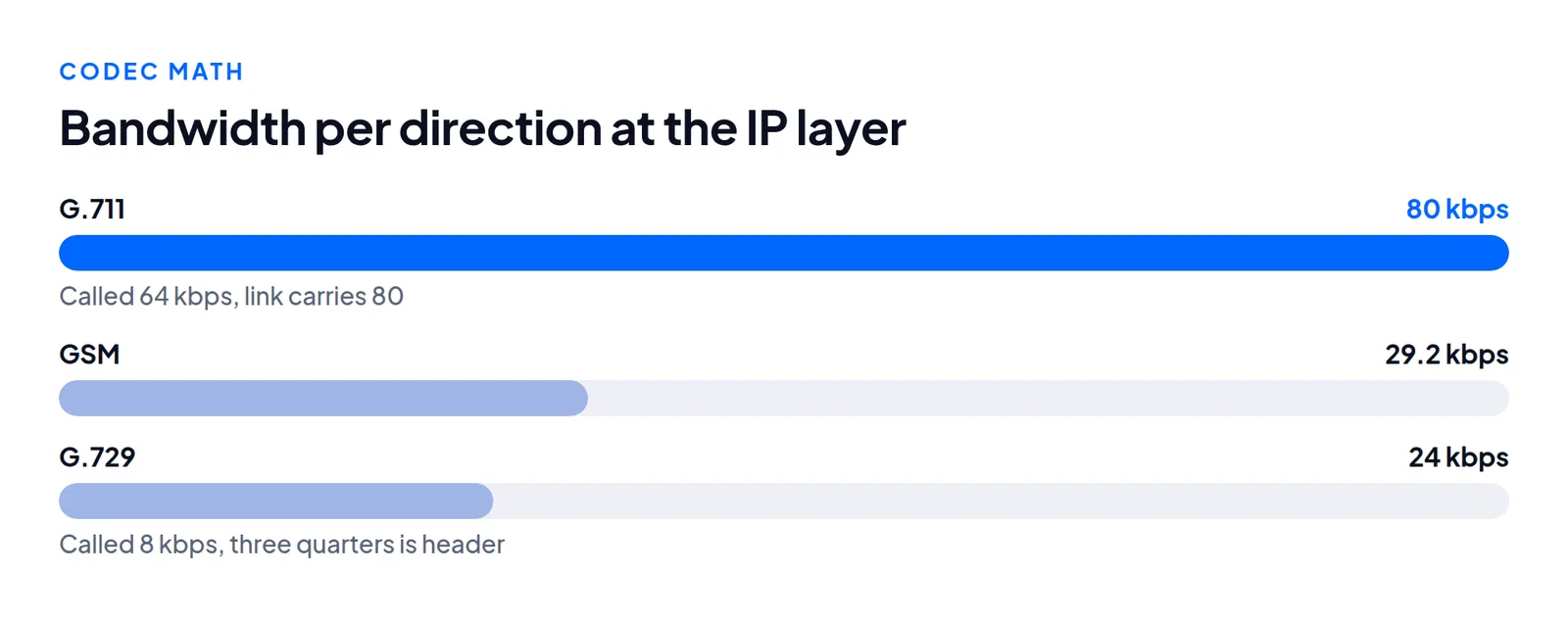
VoIP sends a packet every 20 milliseconds, so 50 a second. Each has a payload and a header stack that does not shrink with the codec: 12 bytes of RTP, 8 of UDP and 20 of IPv4, 40 in all. Payload sizes come from RFC 3551.
| Codec | Payload per 20 ms | Packet at IP layer | Rate |
|---|---|---|---|
| G.711 (ulaw or alaw) | 160 bytes | 200 bytes | 80 kbps |
| GSM | 33 bytes | 73 bytes | 29.2 kbps |
| G.729 | 20 bytes | 60 bytes | 24 kbps |
Packet size times 8 bits times 50 gives the rate. Two additions apply to a real link:
- Ethernet framing adds about 18 bytes a packet. G.711 becomes 218 bytes, about 87 kbps.
- SRTP, which a browser phone uses, appends a tag, commonly 10 bytes. G.711 becomes about 84 kbps at the IP layer.
G.711 is called 64 kbps but the link carries 80. G.729 is called 8 kbps but carries 24, because three quarters of every packet is header. Figures are per direction. A phone sends and receives, so an agent needs 80 kbps down and 80 up, and upload runs out first on a home connection.
What an agent really needs
Add the browser page, which polls the server while the agent works. We did not measure that traffic and have no number. It is small next to voice, so test a real agent session before settling a figure. A sensible budget on G.711 is 100 kbps each way. For a compressed codec, 50 kbps.
A VPN adds dozens of bytes per packet, so a G.711 call on a tunnel can pass 100 kbps alone. On busy Wi-Fi a good 50 Mbps plan can still give a bad call. Plan for latency and loss before bandwidth: LAGGED agents and the network.
The server counts two legs
An outbound call has an agent leg and a carrier leg, and Asterisk is normally in the path of both.
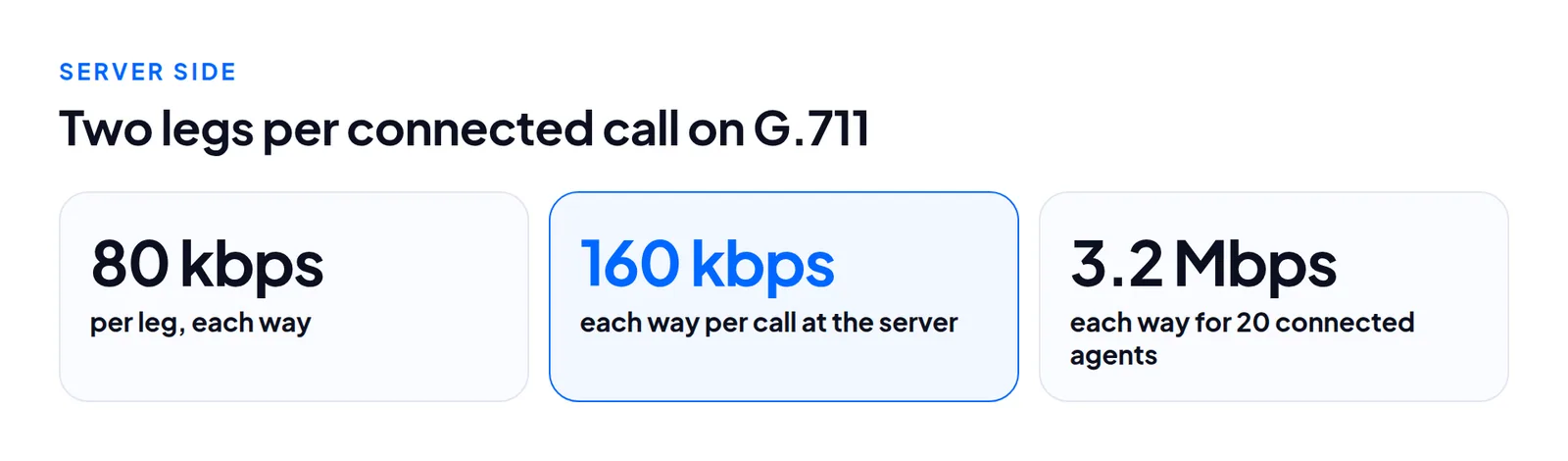
If the agent side is compressed and the carrier side is G.711, the server transcodes. That costs processor time, not bandwidth, and is a reason to keep codecs the same end to end. Recording writes to the server's own disk (recording storage). Listening in or barging adds a stream to the supervisor.
Lines are not agents
The dialer places more calls than there are agents. Lines wanted are the dial level times the agents counted, so a predictive campaign at level 3 can have about three lines per agent. The history we studied peaked at 62 concurrent calls with about 20 agents, one server and one mix, so an example, not a rule.
Most lines are ringing. Carriers commonly send ringback as audio, so some ringing calls carry RTP; we did not measure how many. The safe ceiling counts every line at full rate: 60 lines at 80 kbps is 4.8 Mbps each way, and the truth will be lower.
Set it up, step by step
The ceiling you can state exactly is the box-wide line limit. The picture is our test server.

- Max Trunks (
max_vicidial_trunks): ViciBox 12 ships 23. At 80 kbps that is 1.84 Mbps. If you raise the limit, raise the link estimate with it. See lines per agent.
A worked example
All arithmetic, for 25 agents on G.711 to browser phones:
| Item | Calculation | Result |
|---|---|---|
| Agent legs | 25 x 80 kbps | 2.0 Mbps each way |
| Carrier legs, 25 connected | 25 x 80 kbps | 2.0 Mbps each way |
| Server total | sum of both | 4.0 Mbps each way |
| 50 unanswered lines at the ceiling | 50 x 80 kbps | up to 4.0 Mbps more |
| Margin of 30 percent | 8.0 Mbps x 1.3 | about 10.4 Mbps |
A "100 Mbps" shared link is a ceiling, not a promise. A dedicated gigabit port has no problem with this. The constraint is almost always the agents' own connections.
Check your own floor
Stay with G.711 unless a link forces you off. Every carrier supports it. We did not test codecs against answering machine detection.
Questions people ask
How much upload does a home agent need?
About 80 kbps on G.711 for the call, so budget 100 kbps for the page and jitter.
Does a ringing call use bandwidth?
Sometimes, if the carrier sends ringback as audio. We did not measure how often.
Next steps
Compute the rate for your codec, multiply by connected agents and the line ceiling, add 30 percent, then measure one busy hour. Hosting near your carrier and agents helps call quality more than a cheaper codec: see VICIdial hosting and pricing.
VICIdial is a trademark of its owner. Trustane is an independent hosting provider.
Sources
- RFC 3551, RTP profile for audio and video conferences
- Capacity findings, lines per agent and the trunk cap
- RFC 3550, RTP
- Cover photo by Atlantic Ambience on Pexels
Managed VICIdial hosting