Answering machine detection in VICIdial: settings and accuracy
Where VICIdial's answering machine detection settings really live, what each one does, and what 22,954 logged decisions say about how often it is right.
To the point
On the ViciBox 12 server we examined, answering machine detection is set by eight numbers written inline in the dialplan, not in amd.conf. When the detector says HUMAN it is usually right. Its biggest verdict, MACHINE, was never checked by anyone.
/etc/asterisk/amd.confchanges nothing for campaign calls, because all eight arguments are overridden inline.- Of 22,954 logged decisions, 57% were MACHINE and none of those calls reached an agent.
- Agents marked 4.7% of HUMAN calls as machines (182 of 3,856).
- 85% of NOTSURE calls were not machines, and VICIdial sends them to agents by default.
Where the settings really are
A campaign that uses AMD routes its calls through extension 8369, 8373 or 8375 in extensions.conf. Each plays a moment of silence, runs Asterisk's AMD() application, then hands the result to VD_amd.agi. On our server the call looked like this:
AMD(2000,2000,1000,5000,120,50,4,256)The Asterisk documentation says amd.conf supplies defaults that arguments override. Here every one of the first eight is overridden. If you tuned amd.conf and saw no change, that is why. These lines are in extensions.conf, not the generated extensions-vicidial.conf, so a config rebuild does not rewrite them.
Check your own box first:
asterisk -rx "dialplan show 8369@default"Durations are in milliseconds. In order: initialSilence 2000 (more silence than this before speech gives MACHINE), greeting 2000 (a longer greeting gives MACHINE), afterGreetingSilence 1000 (this much quiet after a greeting gives HUMAN), totalAnalysisTime 5000, minimumWordLength 120, betweenWordsSilence 50, maximumNumberOfWords 4 (more gives MACHINE), silenceThreshold 256.
That describes a person who answers fast and says a few words: "Hello?" fits. A receptionist reading a company greeting does not, and the detector calls that person a machine.
Where VICIdial lets you steer the result
AMD() sets AMDSTATUS (MACHINE, HUMAN, NOTSURE, HANGUP) and AMDCAUSE (for example LONGGREETING or INITIALSILENCE). VD_amd.agi logs both to vicidial_amd_log, then routes. By default HUMAN and NOTSURE go to an agent and MACHINE does not.
In VICIdial's admin
Screens from our test server, campaign SUNQ4. Each red marker has a numbered step below the picture.
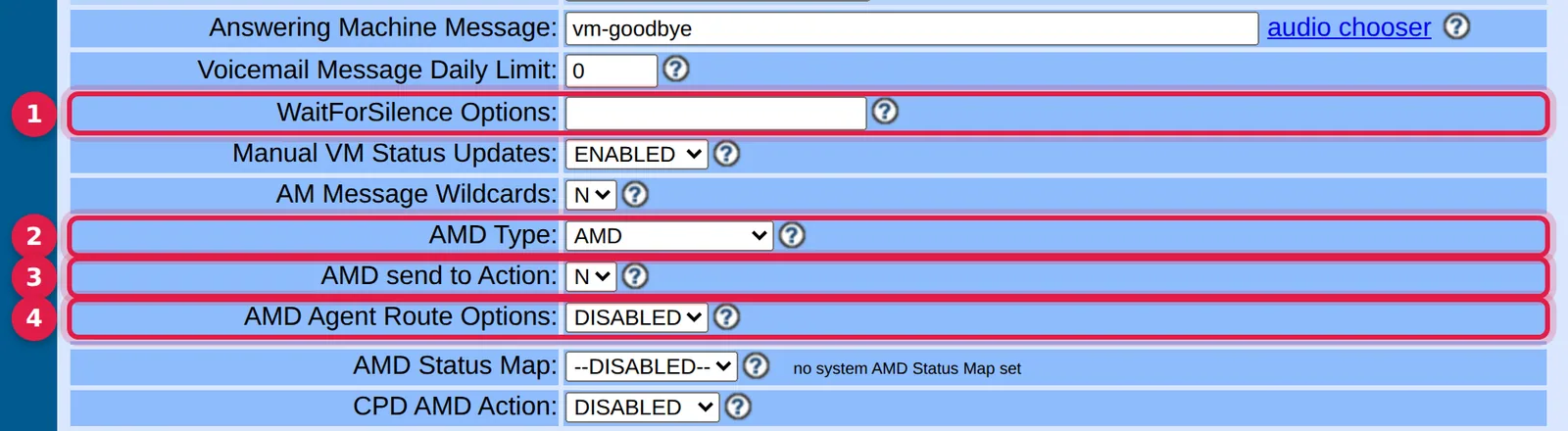
- WaitForSilence Options: used only when leaving a message, to wait for the beep. It does not change whether a call is judged human or machine.
- AMD Type: which engine runs. Only Asterisk's own was installed on the server we examined.
- AMD send to Action: set to
Y, the script waits for silence and plays the campaign's message on the machine path. - AMD Agent Route Options: set to ENABLED, only the exact
STATUS,CAUSEpairs listed in theAMD_AGENT_OPT_container for the campaign reach an agent. No wildcards.
In the Trustane console
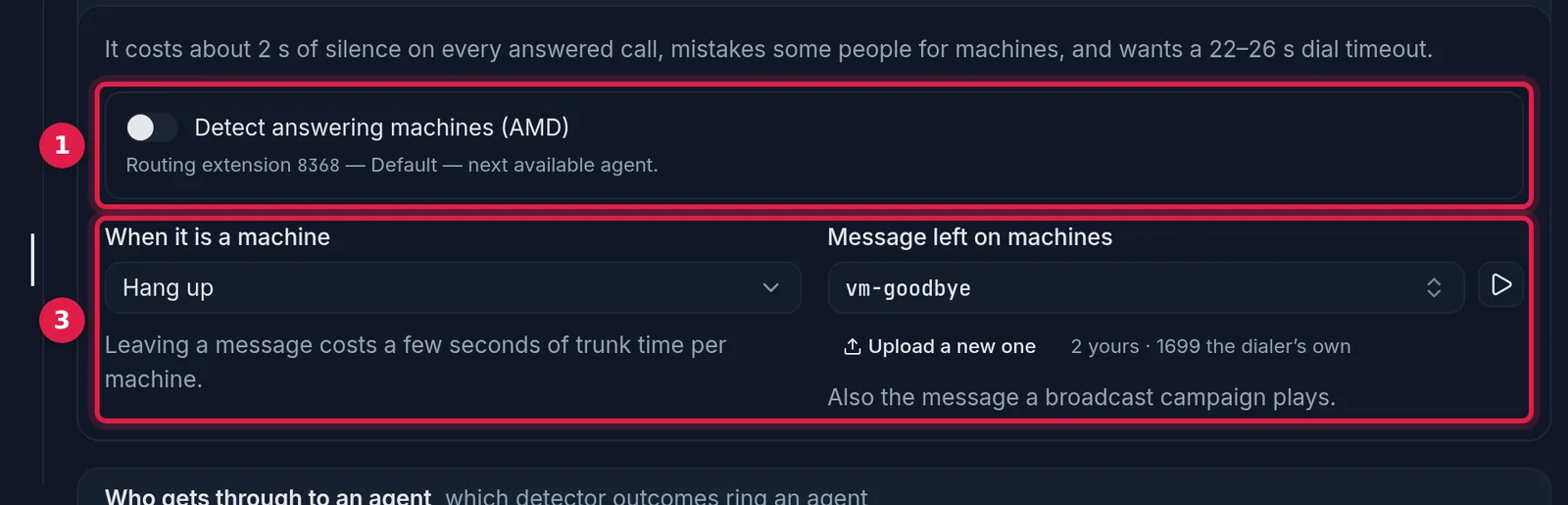
- Detect answering machines (AMD): turns detection on for the campaign.
- When it is a machine: what happens to the call, here Hang up.
- Message left on machines: the audio played on the machine path.
What we measured
The sample was 22,954 decisions over about seven months, joined to vicidial_log by unique ID to see what agents recorded.
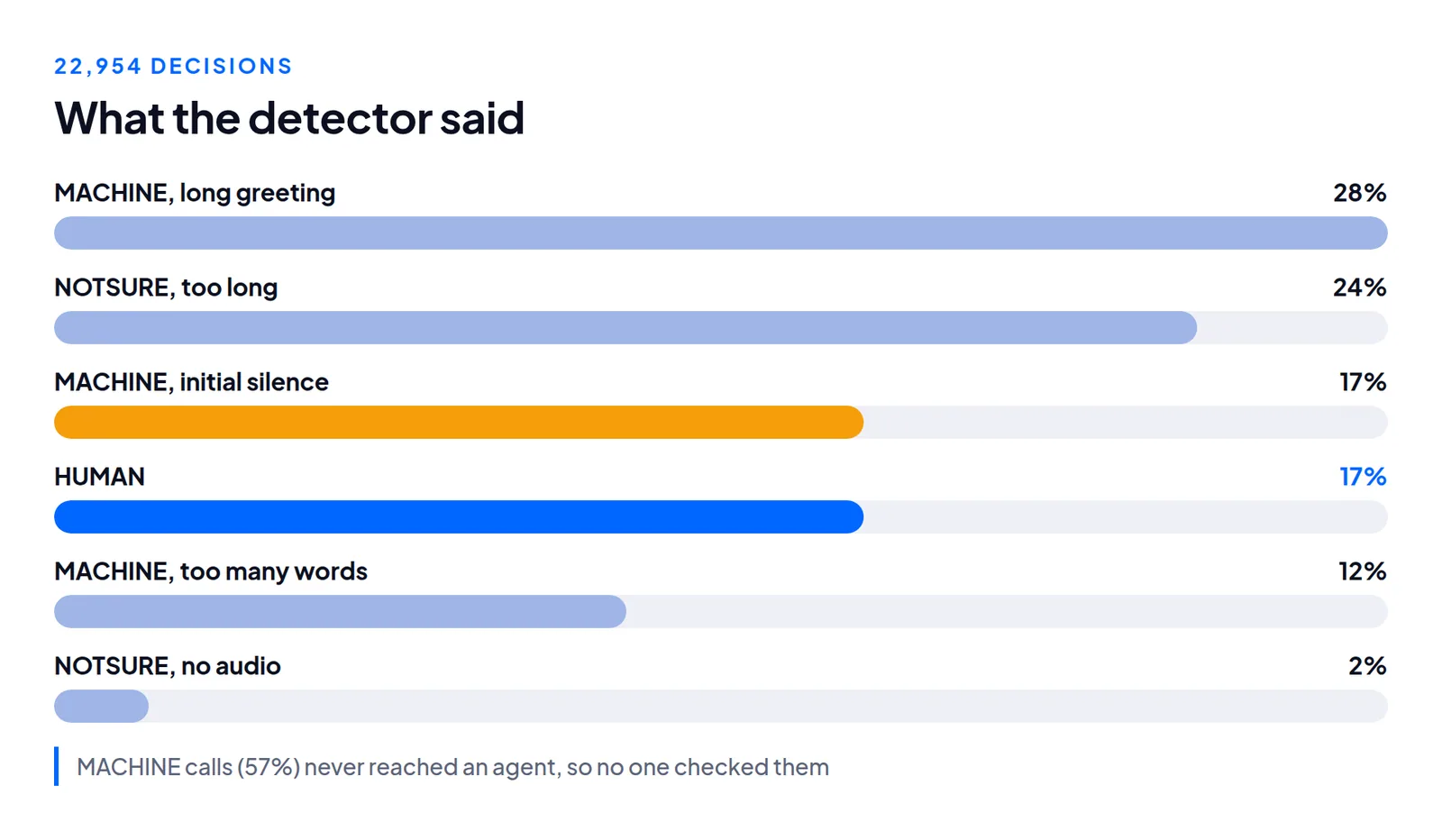
- HUMAN is usually right. 4.7% were marked machines. This is the one error rate we can state, and it depends on honest agent dispositions.
- NOTSURE is mostly people. 85% of them were not marked machines, so routing them to agents was right. The cost is wait: those callers heard 4.8 seconds of silence first.
- The majority verdict was never checked. Nobody recorded whether MACHINE was right. Anyone quoting a false-machine rate without saying how machine calls were verified is guessing.
Find your own false-machine rate
Pick the cause most likely to hide people. On our data that is MACHINE,INITIALSILENCE: someone who picks up and waits looks exactly like it.
- Set
amd_agent_route_optionsto ENABLED on one campaign. - List the pairs you already send, plus
MACHINE,INITIALSILENCE. - Run a normal shift and ask agents to disposition machines accurately.
- Join
vicidial_amd_logtovicidial_logonuniqueidand count statuses per cause. We have only run this on 2.14.
Questions people ask
Why did editing amd.conf do nothing?
The dialplan passes all eight arguments inline, so the file's defaults are never used for these calls.
Should NOTSURE go to agents?
On our data, yes. 85% were people.
Next steps
Run dialplan show 8369@default and record your eight numbers. If agents sit idle, check capacity and lines first, and if nothing dials, read the hopper post. Our hosted console shows verified outcomes per campaign, or see VICIdial hosting.
VICIdial is a trademark of its owner. Trustane is an independent hosting provider.
Sources
- Trustane AMD and caller ID findings, read from VD_amd.agi and extensions.conf
- Asterisk documentation, the AMD application
- Cover photo by RDNE Stock project on Pexels
Managed VICIdial hosting