How many calls can one VICIdial server carry? We measured it
We load tested VICIdial on 2 to 16 dedicated vCPU and read the audio from RTCP. 16 vCPU held about 300 clean calls; the kernel failed first.

To the point
In our load test on 2026-10-30, one VICIdial server with 16 dedicated vCPU carried about 300 concurrent calls with no packet loss. On stock kernel settings, the 2 vCPU server held about 51 clean calls, the 4 vCPU server about 70 and the 8 vCPU server at least 70. On every size, the first errors came from the Linux kernel's UDP buffers, not from Asterisk.
- Clean concurrent calls on stock settings: 2 vCPU about 51, 4 vCPU about 70, 8 vCPU at least 70, 16 vCPU about 300.
- Larger UDP buffers removed every drop: the same 8 vCPU server then held about 293 clean calls.
- Stuck calls appeared only when we overdialed, at dial level 6 to 8.
- Dialer in Helsinki, agent side in Ashburn: 0% loss and a 118 ms round trip.
How we tested
We ordered each server through our own console, so our normal build made it: Ubuntu 24.04, Asterisk 22.5.1 and VICIdial from SVN. Each one ran on Hetzner dedicated vCPU in Helsinki for an hour at most and was then deleted.
No real phone network took part. Two separate Asterisk servers played the two ends of every call: one answered the dialer as the customer, the other answered as the agent. The calls themselves came from VICIdial. We used its remote agents feature, which creates agent seats with no person or browser behind them, on a RATIO campaign at dial level 1.2. The dialer placed the calls, sent each answered call to a seat, and Asterisk bridged the two legs.
"Clean" means 0% RTP packet loss on every leg, read from Asterisk's own RTCP figures (pjsip show channelstats), and no UDP receive errors in the kernel. Call recording was off, answering machine detection was not used, and calls used G.711 μ-law with no transcoding.
The results
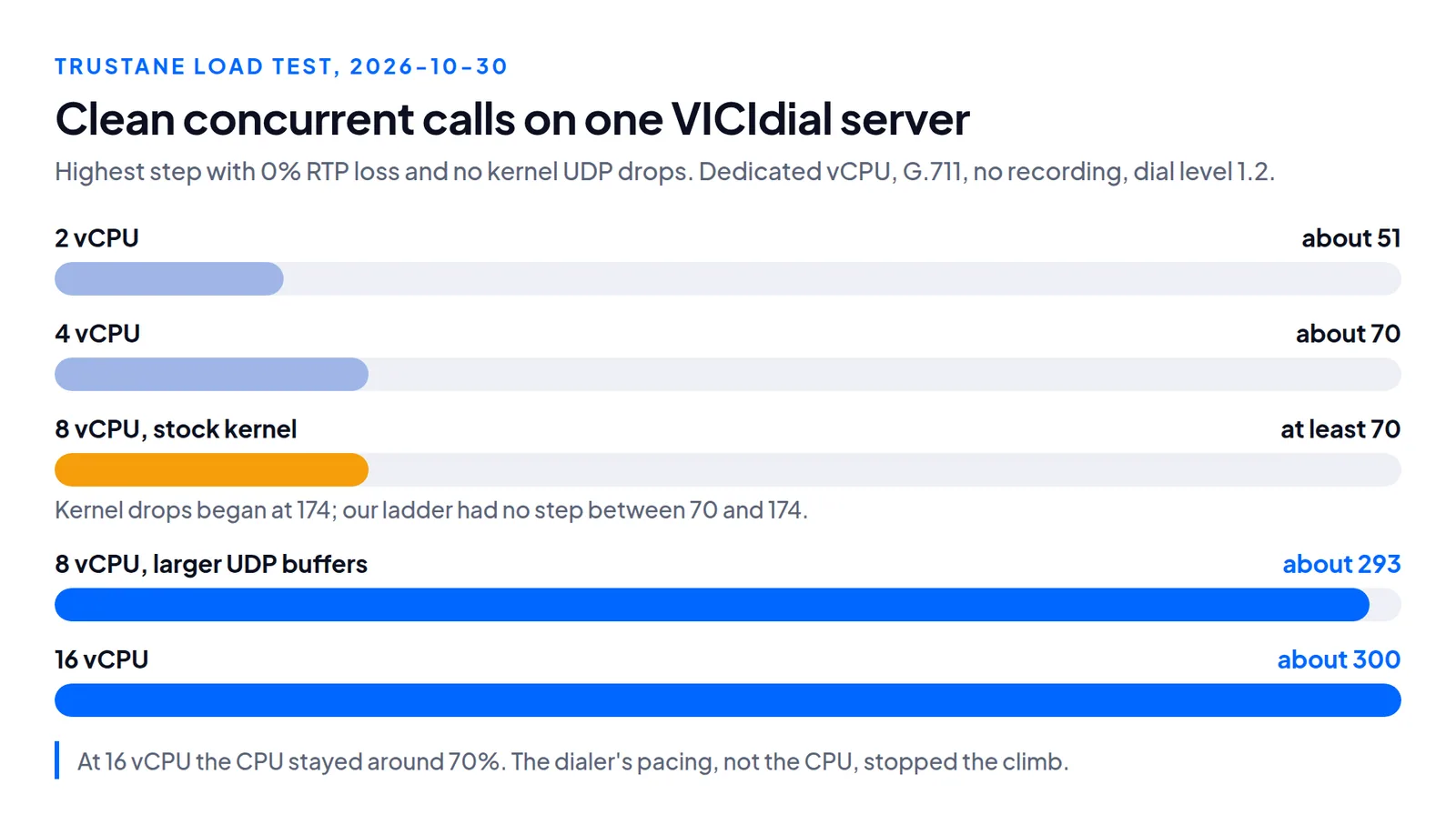
| Server | Highest clean step | First step with kernel UDP drops |
|---|---|---|
| 2 vCPU (CCX13) | about 51 calls | about 77 calls |
| 4 vCPU (CCX23) | about 70 calls | about 126 calls |
| 8 vCPU (CCX33) | at least 70 calls | about 174 calls |
| 16 vCPU (CCX43) | about 300 calls | only on a sudden jump of 150 seats |
These are lab numbers from synthetic calls, not a promise of what a working floor will carry: real carriers, recordings, browser agents and transcoding all take capacity.
Our ladder jumped from 70 to 174 calls on the 8 vCPU server, so its clean ceiling lies somewhere between the two. At the clean steps the CPU was far from full: about 52% median on 2 vCPU, 46% on 4 vCPU and about 70% on 16 vCPU. On 16 vCPU, adding seats did not raise the number of calls. The dialer's pacing (calls per second and the answer rate) stopped the climb at about 300, so that server had headroom we did not reach.
The first limit is the kernel
On every size, the first errors were the same: the kernel's UDP receive buffers overflowed and it dropped voice packets. On the 8 and 16 vCPU servers that happened with the CPU at 37 to 60%, well before Asterisk was busy. On the smaller servers it came together with a busy CPU. Stock Ubuntu buffers are small for hundreds of RTP streams arriving at once, and a sudden jump in seats (0 to 150 at once) overflowed them fastest.
We raised the buffers, spread network receive work across all cores, and ran the same ramp on the same 8 vCPU server:
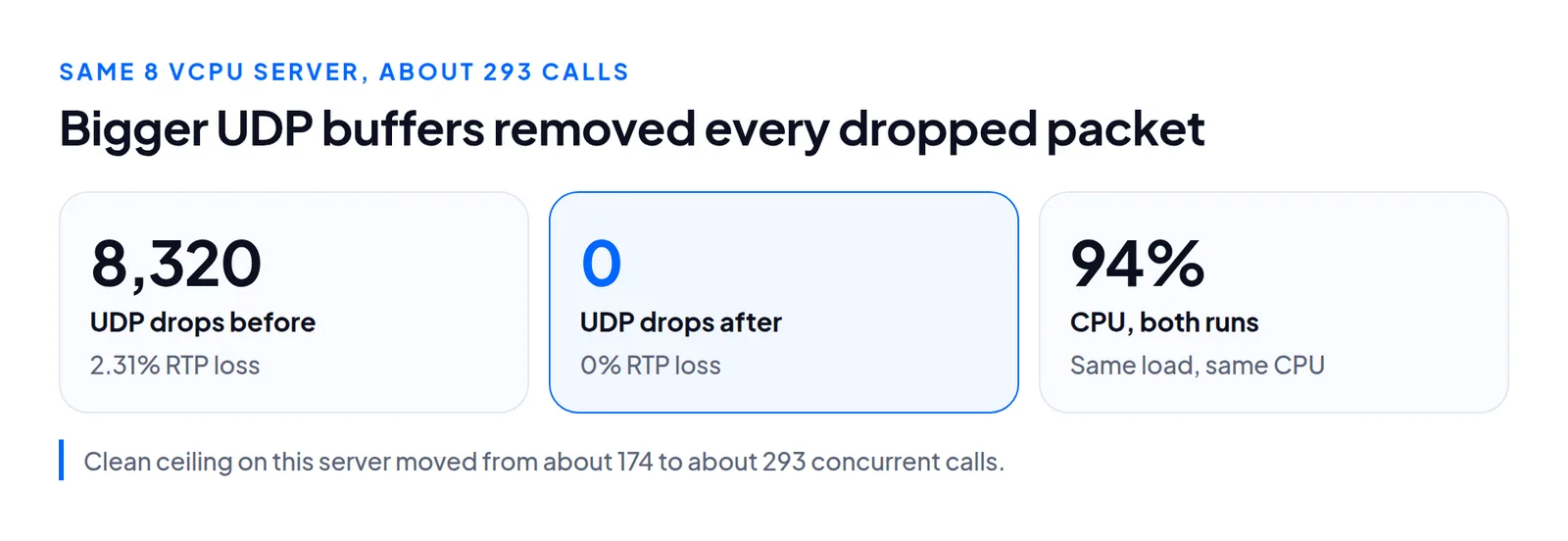
| Load | Drops before | Loss before | Drops after | Loss after | CPU |
|---|---|---|---|---|---|
| about 68 calls | 0 | 0% | 0 | 0% | 14% |
| about 176 calls | 1,190 | 0.385% | 0 | 0% | 48% |
| about 293 calls | 8,320 | 2.31% | 0 | 0% | 94% |
Overdial is what makes calls stick
We saw no stuck calls at normal dial levels. They appeared when we pushed the dial level to 6 to 8. On the 2 vCPU server with 25 seats at level 6, Asterisk held 474 channels at the peak, the manager interface (AMI) ran 43 seconds behind, the kernel dropped 84,000 UDP packets, and no call had clean audio. Across the overdial rounds, hundreds to over 1,000 rows were left behind in vicidial_auto_calls.
Distance costs delay, not audio
We ran about 120 bridged calls with the server in Helsinki and the agent side in Ashburn, Virginia. The transatlantic leg had 0.0% loss, 1 ms median jitter and a 118 ms round trip, against 14 ms for a local leg. That is about 59 ms one way, inside the 150 ms one-way figure in ITU-T G.114. Put the server near your agents to cut delay, not to protect the audio.
What this test did not cover
- Real agents in a browser. The agent screen (
vicidial.php) sends the web server about one request a second for each signed-in agent. We have not measured how many agents a server holds that way. - Recording, answering machine detection and transcoding. Recording was off, AMD was not used and no call was transcoded. Each adds work per call, so we expect fewer clean calls with them on; we did not measure how many.
Questions people ask
Does a bigger server always carry more clean calls?
Not on stock kernel settings. Our 8 vCPU server hit kernel drops at 174 calls, and our ladder could only place its clean ceiling between 70 and 174. With larger UDP buffers the same server held about 293.
Is 16 vCPU enough for 300 concurrent calls?
It was in our test: about 300 concurrent calls with 0.009% loss at the top of the ramp, and the CPU around 70%.
Why did errors start before the CPU was full?
The kernel's UDP buffers overflowed first. Larger buffers removed every drop in our 8 vCPU test.
Next steps
- Size from your own call history: how many lines per agent VICIdial needs and reading capacity from sys_perf_log.
- Choose where the server sits: where to host VICIdial.
- See every size on VICIdial pricing, or order a server that comes with these kernel settings.
The numbers on this page come from Trustane's load test of 2026-10-30. You are welcome to quote them with a link to this page.
VICIdial is a trademark of its owner. Trustane is an independent hosting provider.
Sources
- Trustane load study, results, 2026-10-30
- Trustane load study, method
- Trustane provisioning, the kernel settings a new server gets
- VICIdial SVN r4037, remote agents
- ITU-T G.114, one-way transmission time
Managed VICIdial hosting